
On loneliness, attachment, and living surrounded but untouched
I am not alone.
That’s the cruel part.
There are bodies in my house,
breathing near me,
needing things,
loving me in ways
that still don’t reach
where the ache lives.
I am surrounded
and untouched.
I have no one to call
who isn’t already here,
no voice that exists by choice
instead of obligation,
no place to set down the parts of me
that don’t function on schedule.
I want to be seen.
I am afraid of being seen.
Both truths claw at me
until I bleed inward.
I feel too much.
Every sound stays too long.
Every emotion arrives uninvited
and refuses to leave.
There is no volume knob—
only overwhelm
or silence that screams.
Weeks disappear.
I don’t notice at first—
how the walls begin to close ranks,
how the outside world
forgets my name,
how my body forgets
it is allowed
to move through space.
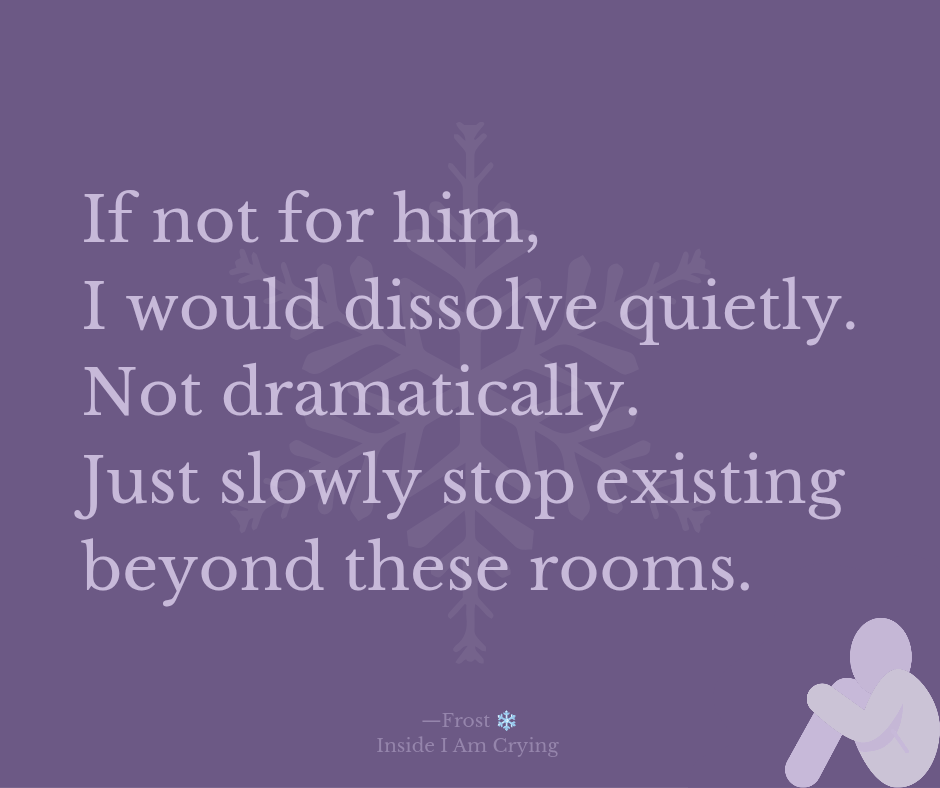
If not for him,
I would dissolve quietly.
Not dramatically.
Just slowly stop existing
beyond these rooms.
Once a week
he pulls me back
into daylight.
A walk.
A reminder.
A tether.
Before forty,
there was no language for me.
Only failure.
Only “try harder.”
Only needs I swallowed
until they calcified
inside my chest.
Forty years undiagnosed
with moderate care needs—
that kind of absence
teaches you
to disappear politely.
I learned early
that survival meant silence.
That being low-maintenance
was the closest thing to love
I would be offered.
My parents are alive,
and they care.
I know that logically.
But connection is a language
my nervous system never learned.
The bond people speak of
like instinct
never anchored in me.
It isn’t neglect.
It’s absence without fault—
a bridge I can see clearly
but cannot cross,
no matter how much I try.
Loneliness doesn’t always look like emptiness.
Sometimes it looks like a full house
with no witness.
Sometimes it is being needed
until there is nothing left
that is yours.
I yearn
like something starving,
but I recoil when fed—
touch burns,
attention blinds,
connection feels like risk.
So I stay still.
I stay inside.
I stay quiet.
Isolation settles in
not as absence,
but as erosion—
a slow wearing down
of the parts of me
that once believed
someone might come
without being asked.
This is what it feels like
to be AuDHD
in a world that never noticed
what it was taking.
Not alone enough to be saved.
Not connected enough to be held.
Just here.
Enduring.
Unseen.
—Frost ❄️
Author’s Note
I am an AuDHD woman diagnosed later in life. I write about isolation, attachment, and unmet care needs through a neurodivergent lens. My work explores the quiet intersections of family, disability, and loneliness, and the ways connection can exist without fully anchoring. I live with my partner and children, and I write as a form of survival, translation, and witness.


Leave a Reply