
Gravidity – A Lyric Essay
This was not morning sickness.
Not nausea.
Not “hyperemesis”.
This was hyperemesis gravidarum;
a severe pregnancy illness
that starves the body
while it is expected to grow life.
Say the whole name.
Anything less makes it sound tolerable.
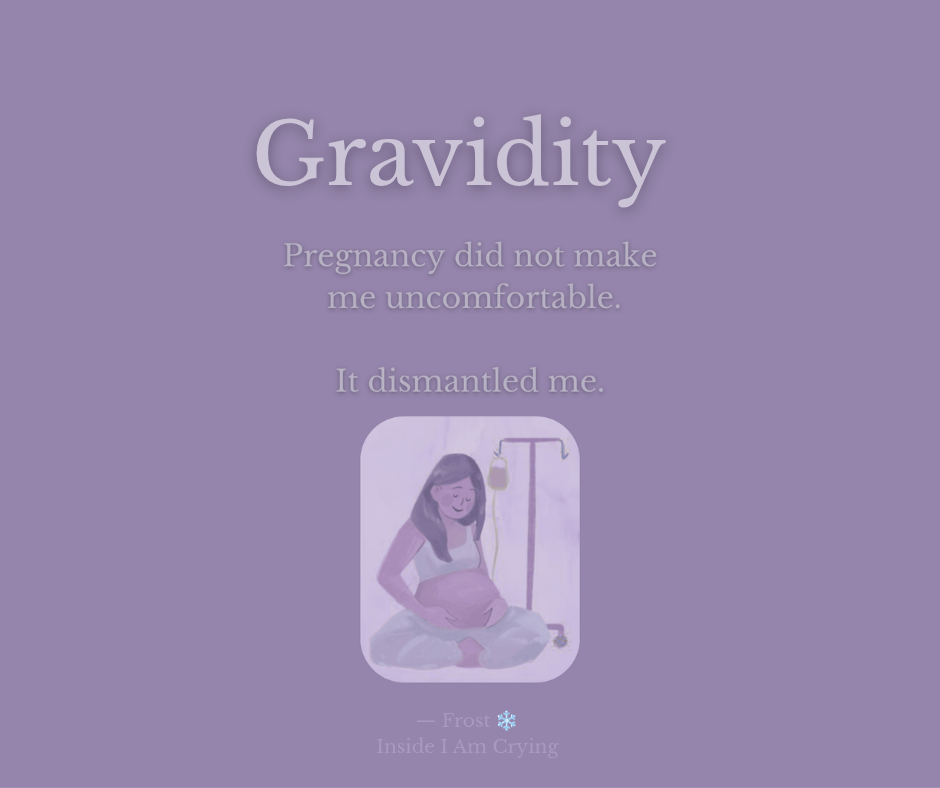
Pregnancy did not make me uncomfortable.
It dismantled me.
My body was stripped of nutrients
until my organs began to ache,
a deep, internal pain,
systems faltering,
warning lights no one checked.
I lived in ketosis.
My body consumed itself
because nothing stayed long enough
to become fuel.
This was not sickness.
This was medical danger.
By morning, I could still pass.
Answer questions.
Hold a cup.
Appear coherent.
By evening, I disappeared.
Six o’clock—
like a switch being thrown.
The illness intensified
as the day accumulated inside me:
light,
sound,
movement,
being upright,
being spoken to,
being expected.
I vomited until there was nothing left.
Then my body tried anyway.
When I was hospitalised,
the vomiting stopped.
And that is where I was misunderstood.
In hospital,
the lights were dim.
The routine fixed.
The world smaller.
My body stabilised.
To professionals,
this looked like improvement.
They never saw the evenings.
They never saw what happened
outside those walls,
when hyperemesis gravidarum
collided with a nervous system
already pushed beyond capacity.
They never saw the full picture.
Once, it was so severe
an ambulance was called.
I was barely responsive.
Depleted.
Offline.
They thought I had taken something.
That I had harmed myself.
Because this is what it looks like
when starvation
and neurological overload
collapse a body at the same time.
I knew I had hyperemesis gravidarum.
I knew I was seriously ill.
What I didn’t know
was why quiet stopped the vomiting
when medication alone did not.
Why evenings destroyed me.
Why my body failed faster
outside contained spaces.
I didn’t yet know
that my nervous system processed the world differently.
I didn’t know
that sensory overload
was running alongside the illness—
multiplying it,
exhausting me further,
leaving no room to recover.
They treated the hormones.
They managed the fluids.
They watched the numbers.
No one asked
what happens
when a person with sensory processing differences
develops hyperemesis gravidarum
and is still expected
to endure brightness, noise, movement, demand.
No one noticed
that my body only stabilised
when stimulation was removed.
This was not exaggeration.
It was not weakness.
It was not failure.
It was a severe pregnancy illness
made more dangerous
by an unrecognised neurological reality.
Pregnancy did not break me.
It revealed a system
that could not see me whole.
And my body,
fighting starvation and overload together— shut me down
to keep me alive.
—Frost ❄️
Author’s Note
This piece describes my experience of hyperemesis gravidarum, a severe and potentially life-threatening pregnancy illness. It is not about “morning sickness”, nor is it a statement about pregnancy in general.
I was diagnosed with hyperemesis gravidarum at the time and understood that I was seriously medically unwell. What I did not know then was that I am autistic with ADHD, and that my nervous system processes sensory input differently. That unrecognised neurological reality meant that sensory overload: light, sound, movement, expectation, compounded the illness in ways that were invisible to professionals.
This is not a claim that autism makes pregnancy dangerous. Many autistic people experience pregnancy without severe complications. This is a record of what happens when a severe pregnancy illness occurs in a body whose sensory needs are unrecognised and unsupported.
The harm described here arose not from autism itself, but from the interaction between hyperemesis gravidarum, sensory overload, and systems that could not see or hold both at once.
This piece is written to name that intersection honestly — for clarity, not fear; for understanding, not generalisation.


Leave a Reply