
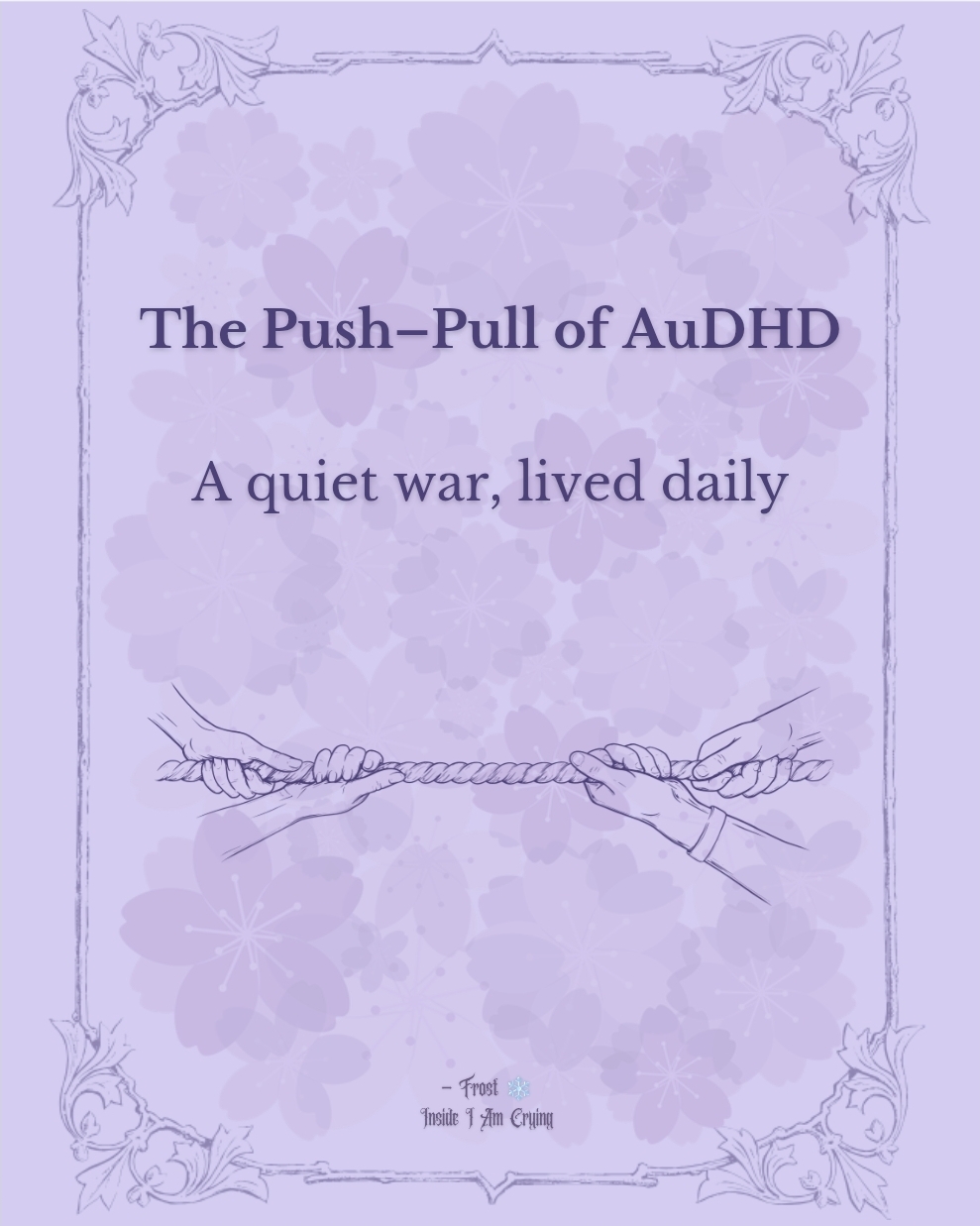
There is a quiet war in me that is hard to explain unless you live inside it.
Autism pulls me toward stillness, depth, familiarity.
ADHD pulls me toward motion, novelty, change.
They do not take turns.
They speak at the same time.
Some days I wake up already tired, not because I’ve done too much, but because my nervous system has been negotiating all night.
I want to go out.
I want to stay home.
I want connection.
I want silence.
I want to begin.
I cannot start.
From the outside, it can look like indecision or inconsistency.
Inside, it feels like holding two opposite truths in the same body.
The Pause
One of the hardest parts to explain is the pause.
The moment where I want to do something, desperately, sincerely, and my body does not move.
It isn’t laziness.
It isn’t lack of interest.
It isn’t defiance.
It is my brain running two operating systems at once, each issuing different instructions.
Autism asks for predictability and safety.
ADHD asks for stimulation and urgency.
So I stall.
Not because I don’t care,
but because caring pulls me in two directions.
This is often where social hangovers begin.
Not after the event, but before it has even happened.
The effort starts early.
The recovery takes longer.
Interests That Won’t Stay Still
I envy autistic people who have a single, lifelong special interest.
I love that certainty.
That depth.
That anchor.
My mind doesn’t work like that.
I don’t have one interest;
I have many.
They arrive intensely.
They leave suddenly.
I can wake up one morning and feel nothing for the thing that lit me up the day before.
That hurts my autistic side.
Because when I love something, I love it deeply.
I organise my world around it.
I feel safe there.
When ADHD moves on, autism grieves.
It feels like loss. Not boredom.
Like being abandoned by something that made sense.
So instead of knowing everything about one subject,
I carry fragments of many.
Little collections of joy.
Little unfinished worlds.
That is not a flaw.
But it is tiring.
The Misunderstanding
Neurotypical language doesn’t always have room for this.
People want consistency.
Follow-through.
Clear preferences.
They don’t see the internal labour it takes to live inside contradiction.
They don’t feel how hard it is to explain: “I want this — but not like that.”
“I love this — but I can’t right now.”
“I’m excited — and overwhelmed — and grieving — all at once.”
AuDHD is not autism plus ADHD.
It is a third experience entirely.
One shaped by friction.
Learning the Signs
I’m still learning how to spot the war before it burns me out.
Some days it shouts.
Other days it whispers.
But naming it helps.
Not to fix it.
Not to control it.
Just to notice: Ah. This is the push–pull again.
And maybe, slowly, to stop blaming myself for it.
For Those Watching From the Outside
If you love someone with AuDHD, know this:
We are not unreliable.
We are not flaky.
We are not careless with our interests or our energy.
We are navigating a nervous system that is always negotiating.
Sometimes the bravest thing we do is pause.
Sometimes the kindest thing is to let us change our minds without shame.
For Me
This isn’t a finished understanding.
It’s a marker on the path.
A reminder that when I feel stuck, scattered, or strangely sad over something I once loved,
I’m not broken.
I’m just living in the space where push and pull meet.
And learning, slowly, how to stand there without tearing myself apart.
—Frost ❄️


Leave a Reply