
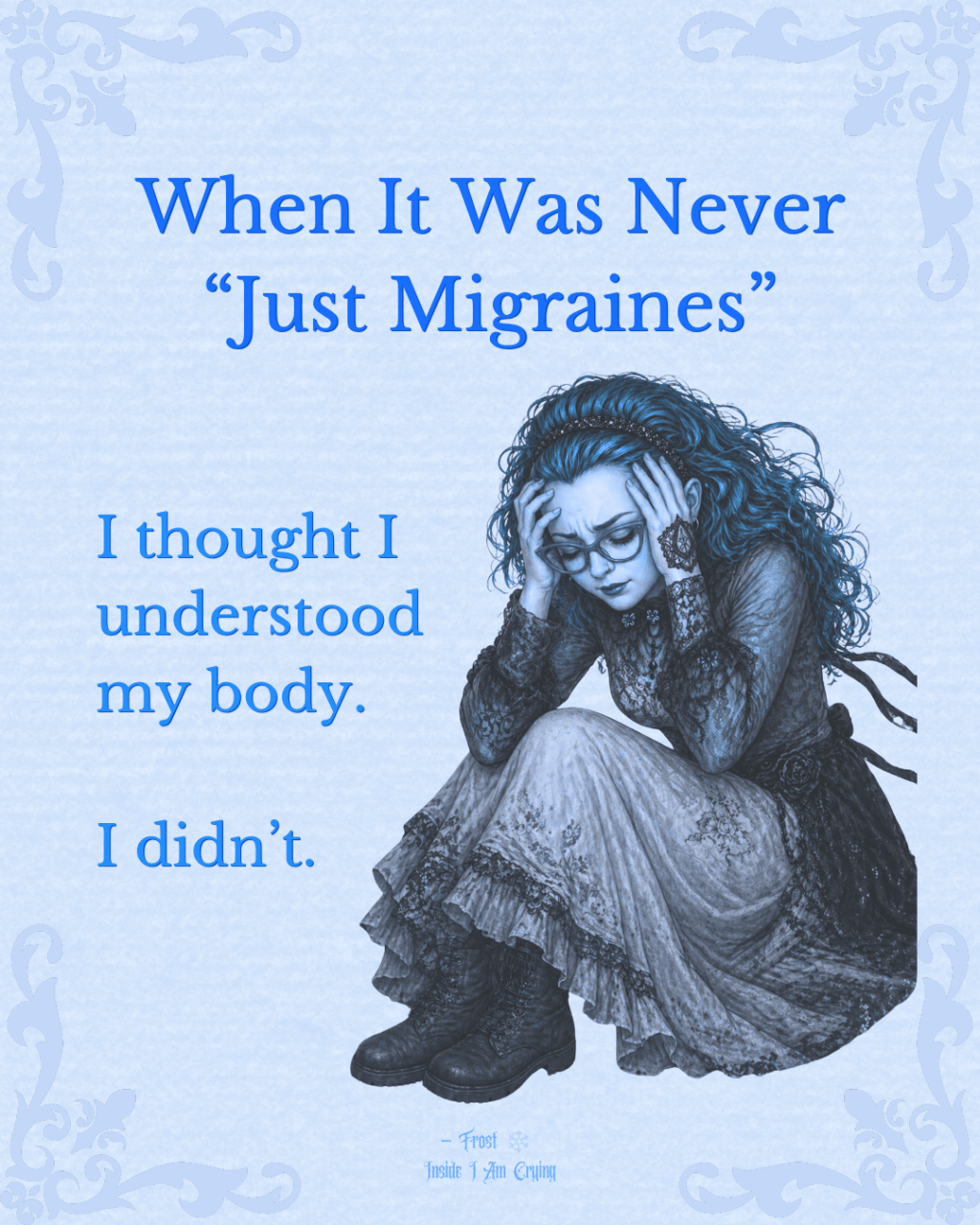
For most of my life, I believed I had migraines.
That was the language available to me.
That was the box my symptoms fit into neatly enough for everyone to nod and move on.
Head pain.
Light sensitivity.
Nausea.
Overwhelm that seemed to arrive without warning.
My body aching.
Migraines made sense.
What I did not understand, what no one explained, was that many of these episodes were not neurological storms appearing out of nowhere.
They were my nervous system reaching capacity.
The Pattern I Could Never Quite Explain
For years, I noticed something quietly confusing.
The pain often followed busy environments.
Bright shops.
Noisy spaces.
Long days upright and “on.”
But because the final symptom was a headache, the earlier signals were dismissed; by professionals and, eventually, by me.
I learned to treat the ending.
Painkillers.
Dark rooms.
Rest after the fact.
What I did not yet know was that my body had been whispering long before it started shouting.
The Missing Piece: Sensory Load
Understanding my AuDHD changed the entire map.
Suddenly, experiences I had normalised began to reorganise themselves into something clearer:
• the way supermarket lighting made my eyes ache
• the way layered noise made my shoulders creep upward
• the way my thinking slowed in busy spaces
• the way exhaustion arrived long before pain
What I had been calling “random migraines” were often the end stage of unrecognised sensory overload.
Not every time.
But often enough to matter.
Overload Does Not Always Feel Dramatic
One of the biggest misconceptions I carried was this:
I thought sensory overload had to feel extreme to be real.
It doesn’t.
Often it feels like:
• pushing through
• staying functional
• remaining polite
• continuing the task
Right up until the body quietly runs out of room.
By the time the headache arrived, the actual overload had usually been building for hours.
Sometimes all day.
What Changed Once I Understood
The shift was not immediate.
But it has been steady.
Instead of only treating the aftermath, I began experimenting with reducing the load before my body reached its limit.
Small things first:
• shopping earlier when it is quieter
• trialling Loop earplugs in busy spaces
• building in decompression time after outings
• paying attention to lighting, not just noise
• noticing the first signs of cognitive slowdown
None of this is dramatic from the outside.
Inside my nervous system, however, the difference is measurable.
The Quiet Relief of Being Believed by My Own Body
One of the most unexpected changes has been emotional.
For years, I thought my body was unreliable.
Overreactive.
Difficult.
Prone to problems I could not predict.
Now I see something very different.
My body was not malfunctioning.
It was communicating in the only language it had available.
Pain was never the first message.
It was the last one.
This Is Not About Fragility
Understanding sensory load has not made my world smaller.
If anything, it has made it more navigable.
Because when you know what your nervous system is processing, you can make choices with far more precision.
Not to avoid life.
But to move through it with less unnecessary cost.
I Still Get Migraines
And this part matters.
Not every headache was sensory overload.
Not every migraine has disappeared.
Bodies are complex.
Hormones exist.
Weather exists.
True migraines absolutely exist.
But what has changed is this:
I no longer assume every episode came out of nowhere.
And that knowledge has given me something I did not have before.
Not control.
But clarity.
— Frost ❄️


Leave a Reply