
I can solve a puzzle.
Give me something complex, layered, something that requires depth and thought—and I will meet it there.
I can sit with philosophy, theology, abstract ideas, and not only understand them, but integrate them into how I live.
That part of me is real.
But so is this:
Put me at the side of a road and ask me to cross it, and suddenly I am not the same person.
There are too many variables. Too many movements. Too many decisions that need to be made quickly and without hesitation.
My mind does not slow down—it fragments.
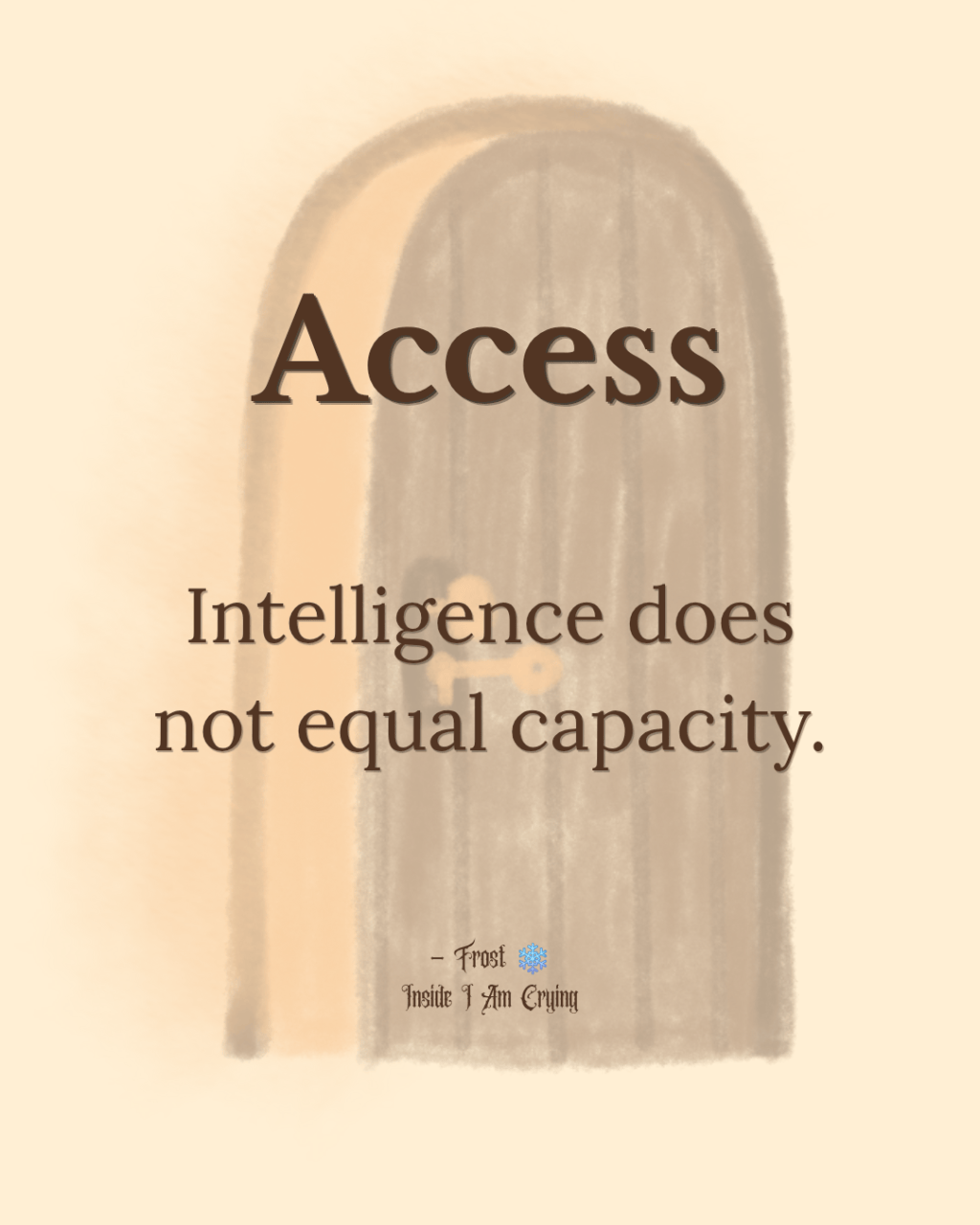
And in that moment, intelligence does not equal capacity.
This is the part people struggle to understand.
How can someone hold complex ideas, articulate them, even teach them—yet freeze when asked something simple?
But “simple” is not simple when the nervous system is overwhelmed.
Capacity is not a fixed trait. It is not something you either have or you don’t.
It is something that shifts depending on: environment, safety, regulation, and who is beside you.
With co-regulation, I can do almost anything.
With the right presence, the right grounding, I can access the parts of me that are otherwise unreachable.
Alone, those same parts can feel distant. Not gone—just… inaccessible.
Like a door I know exists, but cannot open from the inside.
I can understand philosophy. I can question belief systems. I can build a personal framework for living.
And yet, if someone asks me the time at the wrong moment, I might go quiet. Not because I don’t know— but because I cannot reach the part of me that does.
This is not contradiction.
This is capacity.
And maybe the question is not: “Why can you do one thing but not another?”
But: “What do you need, in this moment, to access what is already there?”
Because nothing is missing.
It just isn’t always available.
And that is something I am still learning to live with.
— Frost ❄️


Leave a Reply