
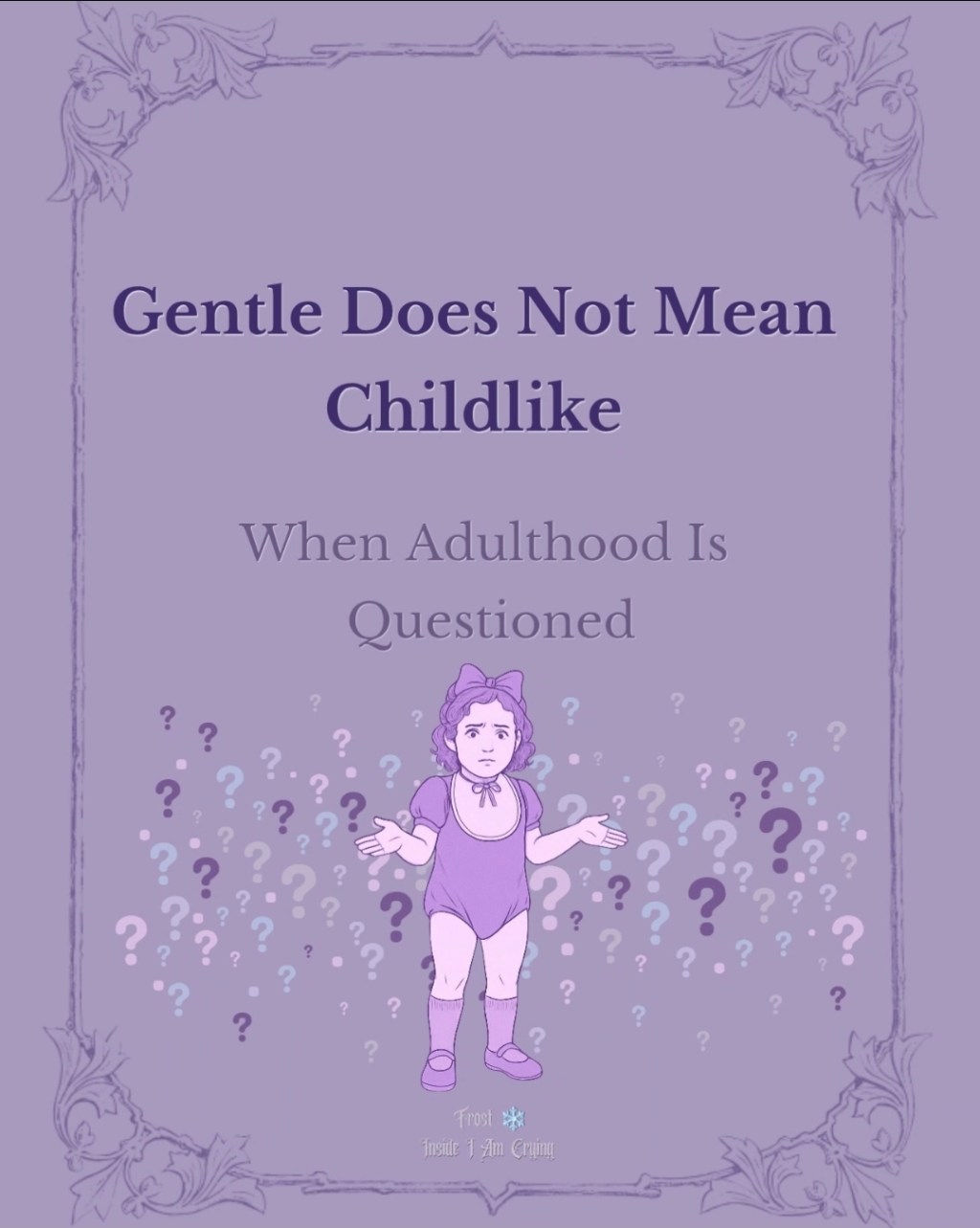
When Adulthood Is Questioned
There is a subtle harm that many autistic adults learn to recognise long before we have the language for it.
It is not always loud.
It is rarely cruel in intention.
But it lands all the same.
It is the moment someone simplifies their voice when they speak to you.
The moment conversations shift when you enter the room.
The coded language.
The careful editing.
The assumptions about what you can “handle.”
Not protection.
Presumption.
Some autistic people are spoken to as though adulthood is conditional, something we must prove we are capable of inhabiting.
As though difference signals fragility.
As though sensitivity means innocence.
As though neurological variation implies a lack of understanding.
But autism does not erase maturity.
It does not suspend awareness.
It does not place a person outside the landscape of human experience.
Autistic adults think about relationships.
About intimacy.
About morality.
About bodies.
About power.
About grief.
About joy.
We understand far more than people often imagine; sometimes more than we wish to.
When people avoid adult topics in our presence, what is communicated is not care.
It is quiet exclusion.
And exclusion, even when politely delivered, is still exclusion.
There is an important difference between supporting someone’s needs and reducing their personhood.
Autistic adults may process information differently.
We may prefer clarity over implication.
Directness over coded speech.
But that is not the same as incapacity.
Often, what looks like innocence is simply a refusal to participate in the unnecessary performance that social conversation can become.
Many autistic people are not naïve.
We are observant.
Deeply so.
We notice shifts in tone.
We register what goes unsaid.
We feel the atmosphere of a room long before anyone explains it.
To be treated as though we do not understand can feel less like kindness and more like being quietly misplaced. Present, but not fully recognised.
And yet, there is another truth that deserves space beside this one.
Some autistic adults describe themselves as childlike.
Not because they are less adult, but because certain qualities survived.
Wonder.
Playfulness.
Direct joy.
Honesty.
Emotional transparency.
These are not deficits.
They are often signs that a person has resisted the social hardening that adulthood can demand.
Childlike is not the opposite of wise.
In fact, it can sit beautifully beside it.
The harm enters when childlike becomes infantilised; when warmth is mistaken for incompetence, when gentleness is interpreted as limitation.
Autistic adulthood does not need to resemble neurotypical adulthood in order to be valid.
There is no single blueprint for maturity.
Some of us pay bills and collect soft toys.
Navigate careers and need sensory refuge.
Hold complex conversations and still find comfort in familiar films.
This is not contradiction.
It is humanity.
If you are ever unsure what an autistic adult understands, there is a very simple solution:
Ask.
Not cautiously.
Not performatively.
Just ask.
Respect grows through curiosity, not assumption.
And perhaps the most important thing to remember is this:
Autistic people do not need smaller lives.
We need accurate ones.
Lives where our competence is not underestimated.
Where support is offered without shrinking us.
Where difference is not mistaken for delay.
Autistic adults are not perpetual children.
We are whole people; carrying insight, desire, humour, sexuality, intellect, and agency.
Speak to us accordingly.
You may find the conversation richer than you expected.
Do not confuse a gentle nervous system with an absent mind.
– Frost ❄️


Leave a Reply