
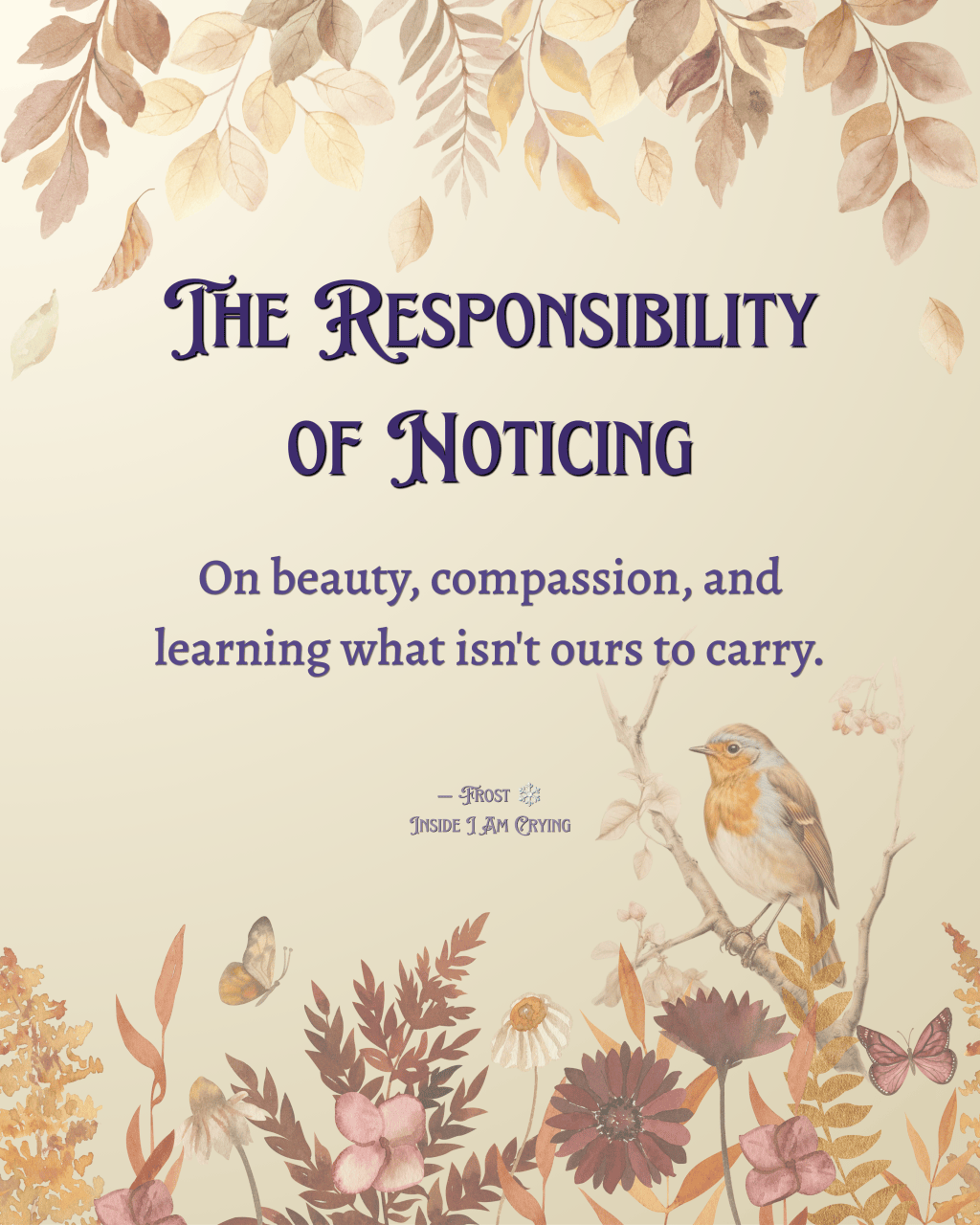
People often talk about noticing the little things. The warmth of the sun on your face. The shape of a cloud. A robin on the fence. The tiny veins running through a leaf.
We’re told these things help us slow down. To be more mindful. More present.
I think they’re right.
But I also think they forget to mention something. Attention is impartial. It doesn’t only notice beauty. It notices everything. The more you train yourself to see, the more you begin to notice the parts of life that are uncomfortable too.
The person who says they’re “fine” but doesn’t quite mean it.
The friend whose every conversation quietly circles back to their own worries.
The teenager whose “I hate bras” isn’t really about bras at all, but about feeling uncomfortable in a body that’s changing faster than they can understand.
The young adult who answers every question with two words because conversation doesn’t come naturally, yet says, “That sounds cool,” when you tell them about something you both love.
The parent who is trying their hardest but is carrying more than anyone else can see.
The child who has stopped asking for help because they learned long ago nobody was coming.
Once you begin noticing, the world becomes fuller. Not always lighter. Just fuller.
This week I read a poem asking whether trees speak to the wind. At first I smiled. Of course they do. Not with words, but with movement. With rustling leaves. With branches that lean and sway.
Then the poem quietly changed direction.
It said that if we can hear the trees in their easy hours, then surely we should hear them later, crying out at the sawmill.
That stayed with me.
Because paying attention isn’t just about finding beauty. It’s about becoming aware of suffering too.
There is a quiet responsibility that comes with noticing. Once you’ve seen something, it becomes difficult to pretend you haven’t.
You can’t unknow the lonely neighbour. You can’t unknow the exhausted parent. You can’t unknow the child who suddenly goes quiet. You can’t unknow the friend who is always carrying tomorrow’s worries into today.
Sometimes awareness feels heavy.
Sometimes it feels impossible to switch off.
For years I thought noticing meant I had to act. If I saw a problem, I had to solve it. If someone was hurting, I had to make them feel better. If a conversation ended without a neat conclusion, I couldn’t rest until I found one.
I confused awareness with responsibility.
But they’re not the same thing.
This week reminded me of that. A friend sent me messages full of worries about money, work and responsibilities. A younger version of me would have climbed into those worries beside her. I would have tried to carry them. Offer solutions. Find reassurance. Leave the conversation feeling as though I’d somehow inherited part of the weight.
Instead, I acknowledged what she shared. I wished her luck with her MOT. I admired the photograph she’d sent. And then I gently left the conversation there.
Not because I stopped caring.
Because I’d finally realised something.
Compassion doesn’t require me to carry someone else’s backpack. Sometimes it simply asks me to walk alongside them for a little while.
Perhaps that’s what attention is really for.
Not to rescue. Not to fix. Not to collect everyone’s sadness until we have no room left for our own joy.
Perhaps it’s simply to witness.To say, “I see you.” And then to trust that seeing is sometimes enough.
The same attention that notices suffering also notices the washing dancing wildly in the wind. It notices dreamcatchers catching the morning light. The excitement of a son talking about Hot Wheels. A daughter finding relief in a binder. A partner quietly making life possible without asking for recognition. A poem that asks impossible questions. A robin that eventually comes back to the feeder.
Life has never been made entirely of beautiful things. Nor entirely of painful ones.
It has always been both.
I think the responsibility of noticing isn’t to hold everything.
It’s to choose, gently and wisely, where we place our attention.
Because attention is like water.
Whatever we keep pouring it into will grow.
And perhaps the greatest kindness we can offer ourselves isn’t to stop noticing the world’s suffering. It’s to remember to notice its beauty with equal devotion.
— Frost ❄️


Leave a Reply